



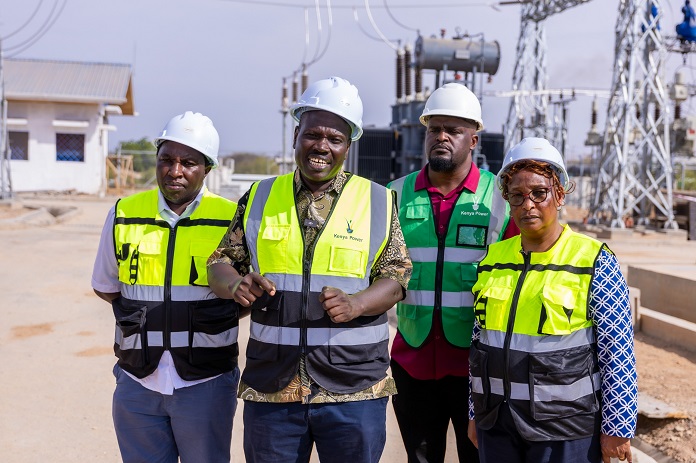
For the first time since Kenya’s independence, Lodwar town and its environs are set to connect to Kenya’s national electricity grid, marking a major milestone in the development of Turkana County and opening a new chapter for the region’s economic growth.
Kenya Power is nearing completion of two major electricity infrastructure projects that will connect Lodwar, the commercial hub of Turkana County, to the national grid.
The projects involve the construction of a 66/11kV Lodwar substation and a 90-kilometre 66kV transmission line between Lokichar and Lodwar. Together, the projects have been funded by the Government of Kenya at a combined cost of KSh1.01 billion.
Once completed, the connection is expected to deliver stable, reliable and cleaner electricity to more than 80,000 residents in Lodwar and surrounding areas, supporting households, schools, hospitals, businesses and other institutions.
For Turkana, Kenya’s largest county by geographical area, the project represents more than an improvement in electricity supply. It is expected to provide critical infrastructure for the county’s next phase of economic and social development.
Moving Beyond Diesel Power
Lodwar and its environs have historically depended on diesel-powered generators for electricity. Kenya Power currently spends approximately KSh900 million annually on diesel to operate the generators serving the area.
The system has also struggled to keep up with demand. Lodwar’s extremely high temperatures place additional pressure on generation equipment, contributing to frequent breakdowns and power rationing.
Kenya Power Managing Director and CEO Dr. (Eng.) Joseph Siror described the project as particularly significant for residents who have relied on generators since independence.
“Since independence, the people of this area and this county have depended on generators, which are not very effective especially in this area, where the temperatures are quite high and running the machines on a 24-hour non-stop basis leads to breakdowns. Connecting this town to the grid means that the residents here will enjoy stable and reliable electricity to power their livelihoods,” said Dr. Siror.
The national grid connection is also expected to generate substantial operational savings.
According to Dr. Siror, the cost of extending the power line and constructing the substation is almost equivalent to the amount currently spent on diesel in a single year.
“Once these projects are complete, we are looking at a situation where what we are saving just in terms of diesel costs for a year is equivalent to the cost of building the line and the substation,” he said.
Beyond the financial savings, replacing diesel generation with grid electricity will eliminate emissions associated with the fossil-fuel-powered generators.
Powering Turkana’s Economic Potential
Reliable electricity could also become an important catalyst for investment and enterprise development in Lodwar and across Turkana.
The county has significant opportunities in livestock trade, tourism, agribusiness and mining, among other sectors. However, the availability and reliability of energy infrastructure remains an important consideration for businesses seeking to establish or expand operations in remote markets.
A dependable national grid connection could improve the operating environment for existing enterprises while making the region more attractive to new investors.
Small and medium-sized enterprises are expected to benefit from more reliable electricity for refrigeration, manufacturing, retail, hospitality, ICT services and other commercial activities.
The improved power supply could also support the development of digital businesses and ICT hubs, giving entrepreneurs and young people greater access to technology-enabled opportunities.
Transforming Essential Services
The impact of the project extends beyond commercial activity.
Reliable electricity can strengthen the delivery of essential public services across Lodwar and surrounding communities. Schools will have greater capacity to support learning after daylight hours, while hospitals and health centres will have more dependable power for critical equipment.
Reliable electricity is particularly important for the storage of vaccines, medicines and other temperature-sensitive healthcare supplies, where power interruptions can compromise essential services.
For households, businesses and institutions that have experienced the limitations of generator-based electricity, the national grid connection is expected to provide greater reliability and predictability.
A New Chapter for Lodwar
The completion of the Lokichar-Lodwar power line and Lodwar substation will also give the town greater capacity to accommodate future electricity demand as its population and economic activity expand.
The investment comes at a time when infrastructure is increasingly central to efforts to unlock economic opportunities in Kenya’s underserved regions.
For Lodwar, connecting to the national grid is therefore not simply an electricity project. It represents a long-term investment in the town’s economic resilience, business growth, public services and quality of life.
After decades of dependence on costly diesel generation, Turkana is now approaching a significant transition — one in which reliable electricity could help unlock the county’s economic potential and provide a stronger foundation for inclusive growth.
The connection of Lodwar to Kenya’s national grid could mark the beginning of a new era for Turkana, powering not only homes and businesses, but the county’s wider development ambitions.