



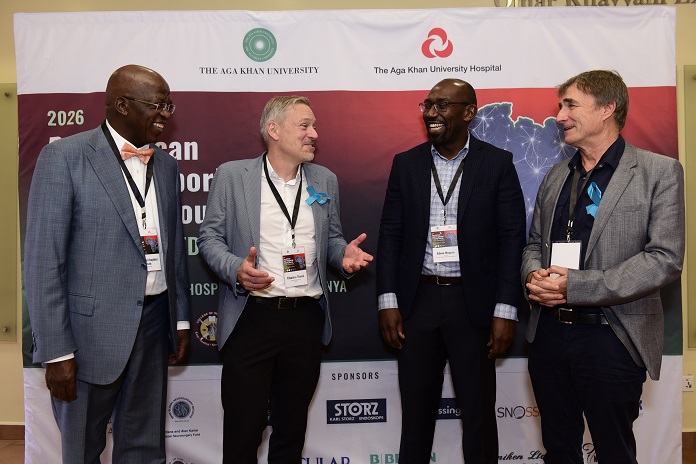
The Aga Khan University (AKU) hosted the Pan-African European Association of Neurosurgical Societies (EANS)-Supported Training Course, bringing together more than 170 neurosurgical specialists, faculty members and residents from across Africa and Europe for specialised training, clinical discussions and knowledge exchange.
The programme which is running till 13th of November is focusing on strengthening neurosurgical expertise across Africa, equipping early-career neurosurgical specialists with current scientific knowledge, practical surgical approaches and the skills to manage complex neurological conditions within the realities of African healthcare systems.
According to a 2024 study published in the Journal of Neurosurgery states that Africa has the lowest neurosurgeon density in the world, with just 0.11 neurosurgeons per 100,000 population, compared with the global average of 0.93 and 2.44 in high-income countries. These figures highlight the significant shortage of specialist neurosurgical expertise across the continent and the urgent need to strengthen training and build local capacity.”
“The neurosurgical training comes at a critical time for the continent. Despite having a population of approximately 1.5 billion people and one of the world’s youngest and fastest-growing populations, Africa continues to face a significant shortage of neurosurgeons and neuroscience specialists,” said Dr Beverly Cheserem, Assistant Professor, Department of Surgery, Aga Khan University Medical College, East Africa and a Consultant Neurosurgeon at Aga Khan University Hospital, Nairobi.
She also added that the neurosurgical training course was developed in response to the need to improve neurosurgical care while ensuring that African specialists remain informed about advances in the rapidly evolving field.
A key focus of the training is neuro-oncology, including brain and spinal tumours, paediatric neurosurgery and neuroendoscopy. These areas were prioritised in response to the growing clinical needs and the importance of keeping pace with the evolving disease classifications, treatment guidelines and surgical techniques.
“The priority is not only to create opportunities to develop surgical skills but also to ensure that we continuously update our knowledge with the latest scientific evidence. We want to build the most competent group of neurosurgeons on the Africa continent, equipped to provide the best possible care to our patients locally,” said Prof Edwin Mogere, Associate Professor, Aga Khan University Medical College, East Africa and a Consultant Neurosurgeon at Aga Khan University Hospital, Nairobi.
Beyond clinical and surgical knowledge, the programme explores how neurosurgeons can apply international best practices in resource-constrained healthcare environments.
“Bringing specialists together allows us to examine the realities of neurosurgical practice across our continents and explore how international guidelines and protocols can be adapted to the local African contexts,” said Prof Claudius Thome, President-Elect, European Association of Neurosurgical Societies (EANS).
Through lectures and case-based discussions, participants will examine complex clinical scenarios, shared experiences from their respective countries and considered practical approaches to adapting established treatment protocols to local settings.
Dr Christopher Musau, President, East African Association of Neurological Surgeons (EAANS) said the collaboration demonstrates the value of learning across different healthcare settings, with both African and European specialists contributing expertise and perspectives.
“Learning should be a two-way exchange. While we benefit from the experience and expertise of our European colleagues, we also have valuable knowledge and approaches developed through our own experiences and the realities of practising in African settings. By bringing these perspectives together, we can learn from one another and develop more effective ways of managing patients and delivering neurosurgical care,” added Dr Musau.
The partnership between African and European faculty was central to the programme, creating opportunities for a two-way exchange of knowledge and experience.
Drawing on the European Association of Neurosurgical Societies (EANS) experience in promoting standardised neurosurgical training across Europe, the collaboration sought to strengthen consistency in specialist education while recognising the distinct realities of African healthcare systems.