



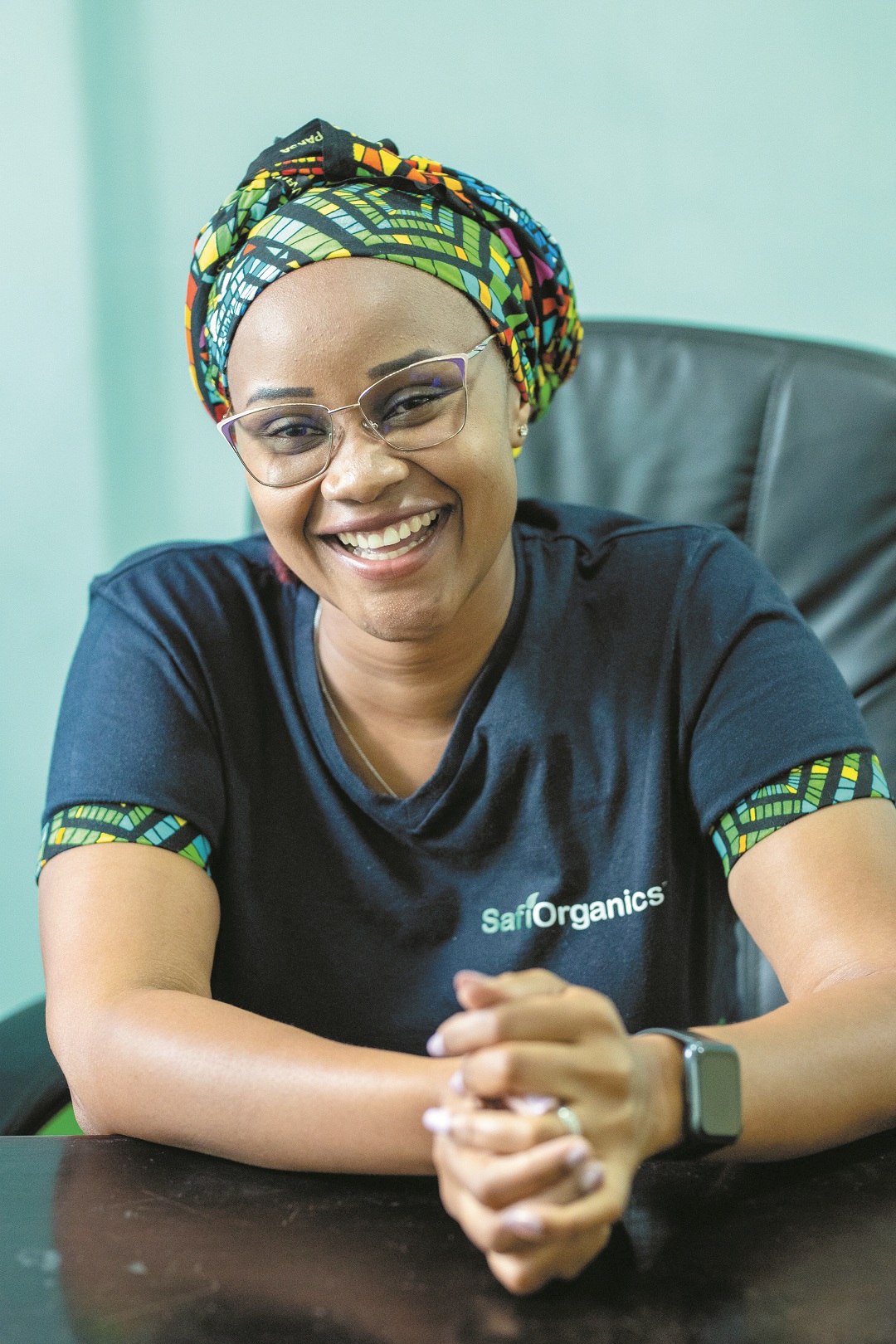
Joyce Kamande was born and bled in a semi-arid area in central Kenya. She is a procurement officer by profession, an agripreneur in career and afarmer by choice and passion; she is a profound environmental enthusiast. Her commitment goes beyond the conventional roles, as she intricately weaves her passion into a powerful mission — to combat food insecurity in Africa. Through the adept use of technology and the ingenious utilization of locally available resources, Joyce is dedicated to transforming the lives of African smallholder farmers. In her pursuit, she embodies the essence of a visionary leader, seamlessly blending professional expertise with a deeply rooted commitment to environmental sustainability and the welfare of communities.
Tell us more about Safi Organics?
Founded in 2015, Safi Organics is a pioneering social enterprise situated in central Kenya, specifically in MweaKirinyaga County. With a robust 5 tons/ day production capacity, our enterprise not only serves over 35,000 smallholder farmers nationwide but also creates direct employment for over 50 youths. At Safi Organics, we leverage the potency of technology, integrating cutting-edge hardware technology and an internetof-things real-time control and sensing system. This innovative approach allows us to decentralize and downsize the fertilizer production process, enabling the implementation of localized production in rural villages. By relying on locally available resources, labor, and waste, we eliminate the need for long-distance fertilizer transportation, significantly reducing costs while delivering a higher-quality product.
Our flagship product, Safi Sarvi, is a locally produced carbon-negative fertilizer. This revolutionary fertilizer not only aids in improving yields by an impressive 30%, but it also reflects our commitment to sustainable and environmentally conscious agriculture. At Safi Organics, we seamlessly combine technology, local resources, and a dedication to community welfare to usher in a new era of accessible and eco-friendly fertilizer production for the benefit of smallholder farmers across the country.
Can you share the story of how you came up with the idea for your business and what inspired you to become an entrepreneur?
During my final year at the university, serendipity led me to meet my cofounder, Samuel Rigu, now our esteemed CEO. Samuel was engrossed in waste management research, and I willingly joined forces. It was in this collaboration that I discovered the profound potential of transforming waste into valuable products that could profoundly benefit our local communities. Our initial foray involved converting rice hulls into briquettes, a venture that faced setbacks when the briquettes proved inadequate even for boiling a simple pot of tea. Undeterred, we pivoted to crafting eco-friendly mosquito coils, an endeavor that saw us successfully sell a staggering 1 million units. Yet, our journey was not without challenges, particularly in fierce competition with rival products. This transformative odyssey from humble beginnings to facing setbacks and adapting demonstrates our unwavering commitment to turning waste into valuable solutions for our communities. After two failed ventures that how we formed our first fertilizer business that has become successful to date.
Was this the line of business you wished to engage in while growing up? Tell us more about your entrepreneur journey?
Hahaha, the whims of childhood dreams! Reflecting on my aspirations of becoming a lawyer as I grew up, it‘s fascinating how life has woven a different narrative—one of a dedicated farmer and agripreneur today. Surprisingly, this unexpected path has brought me to the forefront, passionately advocating for Sustainable Development Goals (SDGs), with a particular focus on No Poverty, Zero Hunger, Climate Action, and more. This unexpected twist adds richness to my life, fueling my determination to make a meaningful impact in the lives of smallholder farmers. Life‘s surprises often lead to the most fulfilling journeys, I would say.
Can you highlight a specific success that you are particularly proud of in your entrepreneurial journey?
Certainly, one notable achievement in my entrepreneurial journey that fills me with immense pride is being a part of the co-founding team that pioneered agroecological practices when the concept was still in its infancy within recovering continent. The profound impact we‘ve achieved is truly astounding—over 600 jobs created, the recycling of more than 25,000 tons of waste, and the sequestration of over 42,000 tons of CO2. This not only underscores our commitment to sustainable practices but also demonstrates our ability to innovate and lead in a sector that has now become pivotal in addressing environmental and economic challenges.
In what ways do you see Safi Organics making a positive impact on the community or industry?
Safi Organics envisions making a transformative impact on both the community and the industry through several key avenues. Firstly, at the community level, our initiatives are designed to empower and uplift. By creating localized fertilizer production units in rural villages, we generate direct employment opportunities, particularly for youths, fostering economic stability and reducing unemployment.Secondly, our commitment to environmentally friendly practices contributes significantly to community wellbeing. By recycling agricultural waste and reducing the carbon footprint associated with traditional fertilizer production and transportation, we promote sustainable agriculture and a healthier environment for local communities.Moreover, Safi Organics‘ focus on smallholder farmers is pivotal. Our carbon negative fertilizer, Safi Sarvi, enhances crop yields by 30%, offering farmers a cost-effective and high-quality solution. This not only contributes to food security but also elevates the economic standing of smallholder farmers, fostering prosperity within the community.On an industry level, Safi Organics stands as a pioneer in decentralized and small scale fertilizer production. By harnessing technology and embracing a circular economy model, we challenge traditional industry norms and set a precedent for sustainable and locally driven practices. This approach not only strengthens the resilience of the agricultural sector but also inspires other industry players to adopt eco-friendly and socially responsible business models.
What have been the most significant challenges you‘ve faced in building and growing Safi Organics, and how did you overcome them?
Building and growing Safi Organics has been a rewarding yet challenging journey, marked by several significant hurdles that demanded resilience and innovative solutions. One of the primary challenges we encountered was the initial skepticism surrounding our decentralized and small-scale fertilizer production model. Traditional practices dominated the industry, and convincing stakeholders to embrace a more localized approach required robust advocacy and education. We tackled this challenge through comprehensive awareness campaigns, engaging with farmers, communities, and industry players. Demonstrating the effectiveness of our model through tangible results and testimonials played a crucial role in overcoming skepticism. Another formidable challenge was the financial constraint associated with technology adoption and scaling operations. Developing and implementing cutting edge technology demanded substantial investments. We navigated this hurdle by strategically seeking partnerships, grants, and investor support. By showcasing the long-term sustainability and impact of our initiatives, we garnered financial support, enabling us to invest in technology and expand our operations.Market competition posed another obstacle, especially when introducing our carbon negative fertilizer, Safi Sarvi. Existing products dominated the market, and establishing our niche required strategic positioning. We addressed this challenge through targeted marketing campaigns, emphasizing the unique benefits of Safi Sarvi in terms of both environmental sustainability and improved crop yields. Building partnerships with agricultural input companies and creating awareness among farmers about the superior qualities of our fertilizer played a pivotal role in overcoming market challenges.
What are your future plans and aspirations for Safi Organics?
We have been operating in the climate change space for a couple of years and our biochar-based fertilizer has demonstrated the potential to sequester 1.7 tons of CO2 from the atmosphere/acre in a year. We are qualifying our product in the carbon trading market such as Puro Earth, as our carbon-rich fertilizer blend sequesters plant-based carbon into the soil for hundreds of years. The carbon payment from the voluntary offset market comprises our second source of revenue. We take a 5% cut and pass the remaining carbon payment directly to the farmers in recognition of the carbon-negative agriculture that they practice. As we scale up, we will work with local agricultural input-output companiesand farmer cooperatives who will operate our village-based fertilizer plant. The hardware will be distributed to them by licensing to a large agricultural OEM and selling as a complementary product through the OEM‘s existing dealership and distribution network. For this we charge license fee to the OEM for the usage of our patents. As a network of village-based fertilizer production plants are produced, the internet-of-things-based control system will enable us to monitor the input feedstock conditions, make autonomous adjustments to the reactor conditions, and customize the fertilizer output to the specific soil and crop requirements at a single-farm granularity. For this optimization based on our software-as-a-service, we will charge an ongoing $20/tonne usage fee.All this alignment will enhance our impact to reach and impact to over 4 million smallholders across the country and help 240 Million smallholder framers rise out of poverty by 2050.
What advice do you have for women who aspire to become entrepreneurs?
The essence of entrepreneurial success is encapsulated in the urgency of ‚Time is Now.‘ Embrace your passion fervently, for therein lies the spark of innovation. Seek out challenges, identify a problem resonating with a specific market, and endeavor to craft a sustainable solution. In this convergence of passion, problem-solving, and timely action, the seeds of a thriving business are sown. The present moment holds the key to transformative endeavors, where the fusion of vision and dedication manifests not just as a business but as a legacy of positive impact and enduring success.A parting shot for women entrepreneurs “Here is to the Strong women, may we know them, may we bring them up and may we be them!
Are there lessons from your entrepreneurial journey that you would like to share with others?
Rome was not built in a day, and entrepreneurship is work in progress and this means you keep learning, relearning until you get your business to world class standards.