



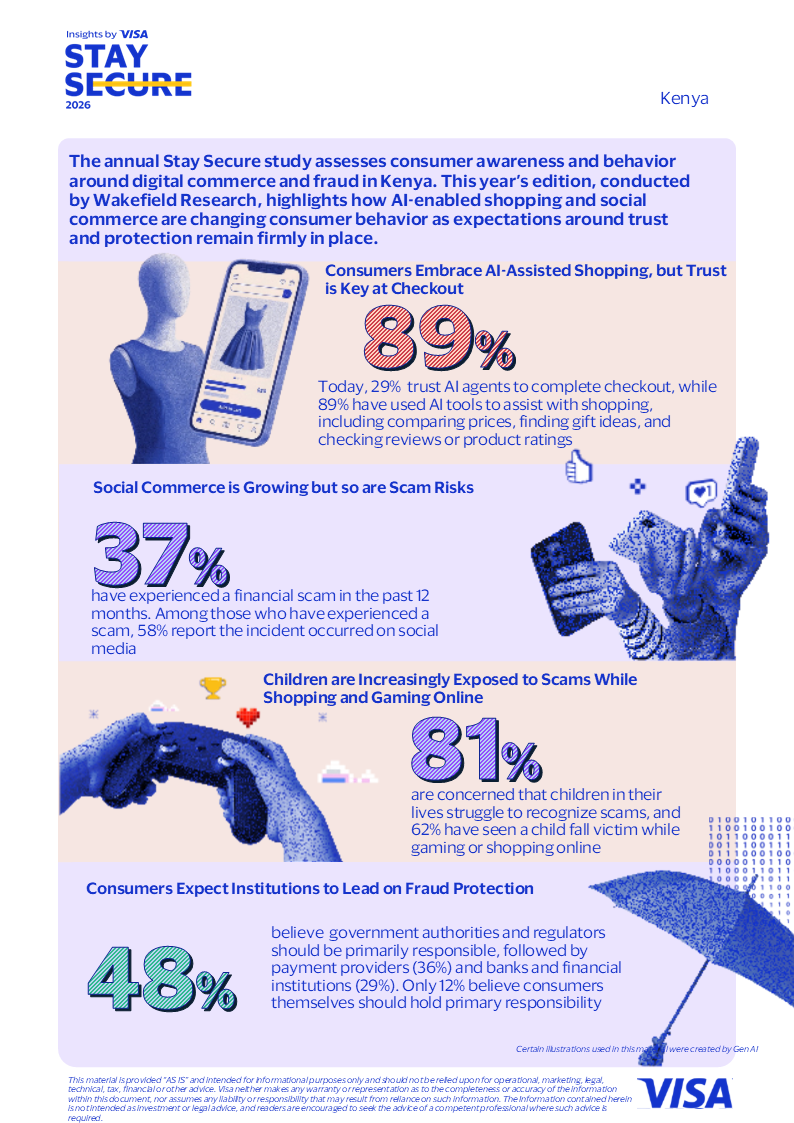
Visa, a world leader in digital payments, today released the annual Stay Secure study in Kenya, which assesses consumer awareness and behaviors around digital commerce and fraud. This year’s edition, conducted by Wakefield Research, highlights how AI‑enabled shopping and social commerce are changing consumer behavior even as expectations around trust and protection remain firmly in place.
Consumers Embrace AI-Assisted Shopping
Consumers are embracing artificial intelligence as part of their shopping journeys. 89% in Kenya have used AI tools to assist with shopping, including comparing prices (53%), finding gift ideas (55%), and checking reviews or product ratings (60%).
The appeal is clear: 91% feel new technologies, including AI-powered tools, are making online shopping faster and easier than before. AI is also influencing discovery, with 61% typically discovering new brands or retailers while shopping online.
However, consumers remain more cautious when it comes to AI handling transactions on their behalf. Today, only 29% would trust AI agents to complete checkout, reinforcing the importance of earning consumer trust in the age of agentic commerce.
As AI adoption grows, consumers increasingly view the technology as part of the solution to fraud. 44% feel AI has made scams easier to recognize today and 82% believe AI will play a critical role in protecting consumers from fraud in the future.
Social Commerce is Growing but so are Scam Risks
Shopping through social platforms has become mainstream, with 85% of consumers in Kenya having purchased products directly through social media platforms. As commerce expands across new channels, fraud risks continue to follow consumers online. 37% have experienced a financial scam in the past 12 months. Among those who have experienced a scam, 58% report the incident occurred on social media, more than those who encountered scams on other platforms such as websites, online marketplaces, or shopping apps.
Children are Increasingly Exposed to Scams While Shopping and Gaming Online
The study also highlights growing concern around how children encounter scams online, with 81% of consumers reporting that children in their lives struggle to recognize scams. A significant 62% have seen a child fall victim to a scam while gaming or shopping online.
That concern comes as children gain greater access to digital commerce. 37% of Kenyan parents have children who can access mobile payment apps or digital wallets.
Consumers Expect Institutions to Lead on Fraud Protection
When it comes to protecting against fraud while shopping online, consumers look first to institutions rather than themselves. 48% believe government authorities and regulators should be primarily responsible, followed by payment providers (36%) and banks and financial institutions (29%). Only 12% believe consumers themselves should hold primary responsibility.
They also want more proactive reassurance. 67% would feel secure receiving real-time alerts from their bank or payment app when something looks suspicious, while 30% would feel more comfortable seeing a familiar, trusted logo at checkout.
“Visa’s Stay Secure study shows that while online shopping and social commerce continue to grow, scams and fraud are evolving too. Consumers see fraud protection as a shared responsibility, but they expect financial institutions, governments, and payment providers to take the lead, underscoring the importance of secure-by-design payment systems,” said Irene Auma, Head of Risk, Sub-Saharan Africa, Visa.
She continued, “As commerce moves toward more agentic, AI-powered experiences, the study shows that consumers are embracing the convenience AI can bring to shopping but remain cautious when it comes to AI completing purchases on their behalf. With Visa Intelligent Commerce, we are helping enable the next era of commerce built on trust, control and confidence.”
To learn more about building trust for a new era of commerce, read the full Visa Stay Secure 2026 Kenya report here
About the Stay Secure Study 2026
The Stay Secure study was commissioned by Visa and conducted by Wakefield Research from January to February, 2026. It involved a survey of 5,800 adults aged 18 years and older across 17 CEMEA markets, including Bahrain, Côte d’Ivoire, Egypt, Jordan, Kazakhstan, Kenya, Kuwait, Morocco, Nigeria, Oman, Pakistan, Qatar, Saudi Arabia (KSA), Serbia, South Africa, Ukraine and the United Arab Emirates (UAE).
Disclaimers:
- Study results reflect customer perception at the time of research and do not predict future behavior or outcomes.
- Results may vary by country, demographic group, and market conditions within the surveyed regions.
- Study findings reflect consumer observations and perceptions and should not be interpreted as professional guidance on child safety or online behavior.
- References to artificial intelligence reflect supporting technologies and insights only. AI‑based tools do not replace human judgment and do not constitute legal, financial, compliance, or professional advice.